





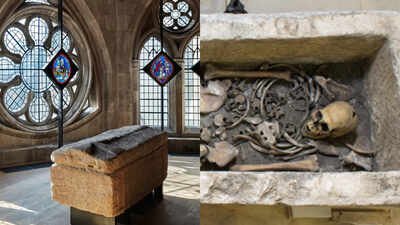
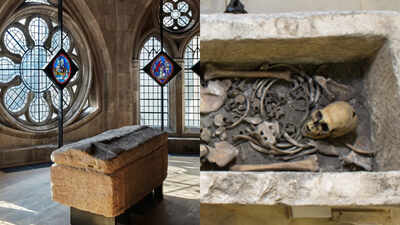
For more than a century, a stone coffin at Westminster Abbey carried the name of a Roman-era Londoner, while the identity of the person buried inside remained hidden. Now, modern forensic and archaeological analysis has shifted the story by several centuries, suggesting the skeleton belongs not to the man named on the ancient sarcophagus, but to a high-ranking medieval monk who may have been one of the abbey’s early abbots, claims the official website of Westminster Abbey.
A Roman coffin with a medieval secret
According to a Daily Mail report, the limestone sarcophagus was first encountered in 1820 during work on the north side of Westminster Abbey, when labourers accidentally damaged its lid. The cover was broken into six pieces and was later repaired before the coffin was formally excavated on the North Green in 1869.An inscription on the sarcophagus identifies Valerius Amandinus, believed to have been a wealthy Briton who lived in London sometime around AD 300 to 400. For years, the inscription appeared to provide a straightforward answer to the coffin’s occupant, the report adds.But another detail complicated the picture, as a large Latin cross carved into the lid is stylistically dated to the 10th or 11th century, hundreds of years after Amandinus would have lived. The discovery suggested that the Roman sarcophagus had been reused long after its original burial, claims the report.
Dating the mysterious remains
If we go by the Westminster Abbey website data, fresh analysis has now provided a much clearer timeline. A bone sample sent to the Scottish Universities Environmental Research Centre for radiocarbon dating placed the skeleton between AD 987 and 1052.That result effectively rules out the possibility that the remains belong to Valerius Amandinus. Instead, the evidence points towards a man who lived during the late Saxon period, when the ancient Roman coffin was repurposed for a new burial.According to Westminster Abbey website, human bone specialist James Young Langthorne of Pre-Construct Archaeology assessed the skeleton as belonging to a man approximately 5ft 9in tall who died between the ages of 35 and 49. The findings also differ from an assessment made in the 19th century, when the remains were described as those of a robust young man thought to be no older than 30.
Two possible abbots
According to Daily Mail, professor Warwick Rodwell, Consultant Archaeologist at Westminster Abbey, believes the most likely candidates are Aelfwig and Wulnoth, two medieval abbots associated with the institution when it was still a Benedictine monastery.Aelfwig served as Abbot of Westminster and died around 1020. His successor, Wulnoth, died in 1049 and is also believed to have been buried at the abbey. Both men fit the new radiocarbon window and the estimated age of the skeleton.The burial itself provides another important clue. Whoever occupied the sarcophagus appears to have been given a relatively prestigious burial. A wooden coffin was placed inside the much older Roman stone container, while its lid was remodelled with a prominent Latin cross.The reuse of an ancient sarcophagus in this way suggests that the medieval occupant was considered important enough to receive an elaborate stone burial rather than an ordinary grave, the report explains.
Traces of a vanished coffin
The investigation has also revealed evidence of another lost part of the burial. Researchers identified the outline of a rectangular structure preserved as a white lime residue around the sarcophagus, states the official website.Although the structure itself had disappeared, the markings indicate that a timber coffin once stood inside or around the stone burial. Over the centuries, the wood completely decayed, leaving only traces behind.Together, the radiocarbon dating, skeletal analysis, carved cross and evidence of an additional coffin have helped reconstruct a burial that was once surrounded by uncertainty.The precise identity of the man may never be established with absolute certainty, but the evidence has narrowed the possibilities considerably. Rather than belonging to a Roman-era Londoner named on the coffin, the skeleton appears to represent a medieval churchman buried centuries later.Images Courtesy: Westminster Abbey