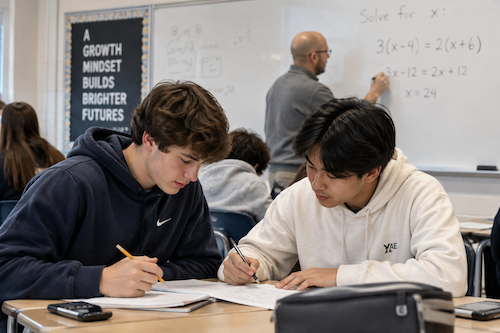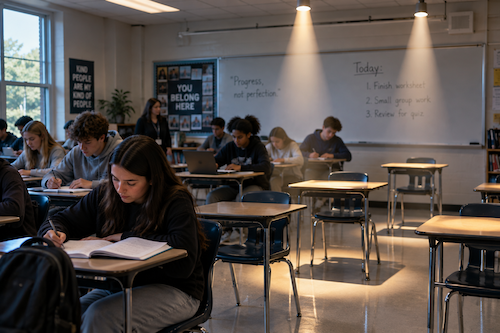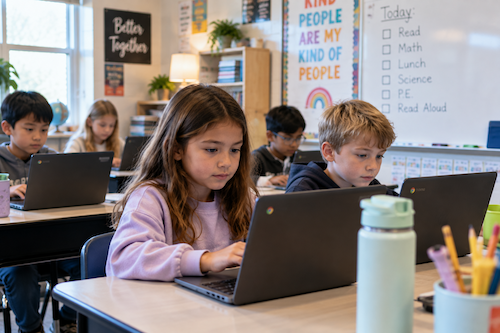









After spending a full week with just pencil, paper, and a willingness to think deeply, students opened up their laptops. Throughout the week, they defined words like “incarceration” and “reparations.” They learned the historical context of World War II and why the U.S. government forced thousands of Japanese Americans to leave their homes for remote relocation centers. They analyzed primary sources. A lot of primary sources. From government documents, newspaper clippings, and personal letters to photographs and propaganda posters. Their papers were marked up with annotations as the classroom filled with conversations around humanity, justice, and understanding.
By the time the unnatural blue light of the computer screen hit the students’ eyes, they had researched, analyzed, and prepared a paper about the impact of incarceration on Japanese Americans during World War II. They did all of this without technology. This begs the question: With such a rich week of learning, why bother pulling out laptops at the end?
Simply, because synthesizing and sharing learning matters. When we don’t confine learning to one classroom but share it across a department or district, we enable systemic change. Technology can facilitate this. A narrow use of technology, one that cements student learning rather than facilitates it, is key for cultivating a student-centered education system.
In the case of the above example, when students submitted their essay on our online platform, they received instant feedback thanks to AI-informed grading. Their teacher can now use this feedback and the resulting data to identify trends in student thinking and writing. This provides essential information to drive student learning forward.
Meanwhile, when other classrooms go through the same process, whole departments become more collaborative. Using the data, teachers can set goals around students contextualizing information, citing textual evidence, and defending arguments. A school’s learning culture shifts because technology enables immediate and actionable feedback for students and clear insights for teachers.
But here is a point that must be stressed: the technology hardly needs to be used to get these results. The technology is there to record the data from student thinking, not to facilitate the thinking or make it ‘fun’.
We believe that leveraging technology in this very specific way—to provide instant feedback and synthesize complex data—can open the door to an education experience that better empowers students. Its use is minimal but strategic, enabling learning experiences that make us more human. In fact, the technology incentivizes the user to stay on it as little as possible. It’s an affront to the algorithm. It’s boring.
We are amidst a clear shift happening in education. For the past decade-plus, schools have been adopting education technology wholesale in our K-12 system. Introducing technology in classrooms was a hopeful salve to the rapidly changing culture our students were growing up in. We hoped that more technology would make us more relevant to digital natives and increase their engagement. But the research is coming to light, and this wasn’t the salve tech optimists hoped it would be. As teacher-turned-neuroscientist Dr. Jared Cooney Horvath argues in his recent book, The Digital Delusion, it may have actually widened the wound of learning resistance.
Of course, this shouldn’t be surprising. When the educational community does not ask human-centered questions about our technological adoption, we’re bound to use it ways that decenter the humanity of our students. Rather than framing a school’s use of technology around the types of thinkers a society needs to thrive, we looked at efficiency, convenience, and a surface-level type of fun. No wonder we are seeing declining test scores and lower attendance. Why would students go to a school system that tries to compete with social media or online gaming? They can get a cooler version of that outside school walls.
Schools must offer students something better, something more human.
Last year, I contributed to the CivXNow and EdSafe AI Alliance education policy report, asking in the conclusion what I continue to believe is a fundamental question for those of us in education: “What is education if not the process of making us more human?” This question, as our report cements, does not mean the complete rejection of technology in schools. It does, however, mean we need to redefine the terms of our relationship.
Thankfully, this is already happening. Earlier this year, Los Angeles Unified School District, the second-largest school district in the nation, moved to create a policy to limit screen time across its schools. Whole states are moving in the same direction. Soon, more states and districts will follow suit, which will force us to dramatically rethink the approach we adopted in education during the first quarter of the 21st century. This coming wave demands a reevaluation and recalibration of the use of technology in schools.
Technology can have a beneficial role in the K-12 experience. But it must be limited. Platforms should consider ways to offload a school’s reliance on their technology. To honor the humanity of the students we serve, we must prioritize their intellectual growth over our usage statistics.
The hammer is a boring but useful tool. More edtech should be too.