








School safety depends on strong community partnerships
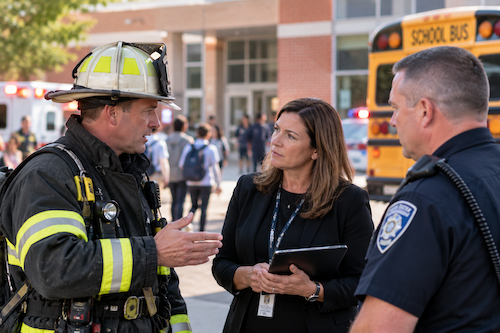
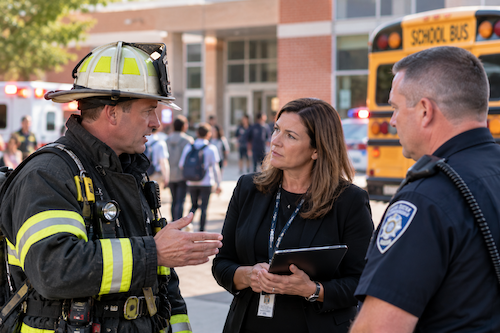
Place yourself at the start of a school emergency. A teacher is trying to communicate what’s happening. A 911 dispatcher is gathering critical information. School leaders are working to understand the situation while first responders start decision-making with whatever information is available.
In those first moments, the outcome of the emergency is already being shaped.
Many people think emergency response begins when police, fire, or EMS arrive on campus. But after more than 30 years in public safety as a firefighter, 911 dispatcher, supervisor, and emergency response technology professional, I have learned that the opposite is true.
The most effective responses begin long before the emergency occurs, through the relationships, communication plans, and coordination schools build with their surrounding community. Ensuring success starts with mastering three fundamentals: speed, clarity, and coordination.
Speed: Reducing the time between an incident and response
One of the biggest misconceptions about emergency response is assuming when someone calls 911, responders can immediately take action. In reality, dispatchers must determine what is happening, where it is happening, and what resources are needed.
That process takes time, especially when callers are frightened, injured, or unsure of exactly what they are seeing. Even small delays, like searching for a phone, relaying information through multiple people, or struggling to explain the situation clearly, can slow response times and impact outcomes.
Schools can help shorten that timeline by establishing emergency communication systems and response plans that quickly connect dispatch centers with accurate and actionable information.
The sooner first responders understand the situation, the sooner they can mobilize resources.
This is especially important in rural communities, where staffing shortages and geographic distance often prolong response times. In some counties, a single officer may cover over 100 square miles, and EMS crews may be responding from 20 to 30 minutes away. Schools in these communities can benefit significantly from proactive coordination and clearly defined protocols.
Clarity: Getting responders the information they need
One of the most important shifts in modern emergency response is the ability to provide responders with detailed mapping information instead of general location data. School campuses are complex. Knowing an emergency is in progress “at the high school” is very different from knowing the exact floor, classroom, and closest entrance to quickly render aid.
When I started in the fire service, we relied on paper map books because GPS and Google Maps were not at our fingertips. I experienced an emergency firsthand where our crew responded to a completely wrong location because an important update had not been made to our map pack. We lost valuable time simply trying to reach the right location.
Today, schools can work more collaboratively with first responders by ensuring campuses are mapped clearly and operational plans are shared proactively. This allows dispatchers and responding agencies to make informed decisions before they arrive on campus.
This also strengthens clarity when different responding agencies are moving simultaneously. Law enforcement, fire personnel, EMS, school resource officers, and school administrators have different responsibilities during an emergency. When everyone can operate from the same information, they work together more effectively and reduce confusion during high-stress scenarios.
Coordination: Building partnerships before an event
The strongest school safety programs are built on relationships, not binders stuffed with emergency plans. Effective coordination depends on schools regularly interacting with the people who support an emergency.
This collaboration should include:
- Joint training exercises
- Shared campus maps and operational plans
- Direct communication pathways with dispatch centers
- Regular reviews of response protocols and access points
These efforts create familiarity and trust. When first responders know the campus, school leadership understands emergency processes, and dispatchers can quickly and efficiently gather the critical information they need, teams operate more confidently and effectively.
A community responsibility
In public safety, we often talk about situational awareness during an emergency, but effective preparation begins long before an incident occurs.
We cannot predict every emergency, but we can prepare for them. Investing in strong community partnerships empowers everyone involved to respond faster, communicate more clearly, and coordinate more effectively when it matters most.