





Seville European Film Festival Fetes Agnieszka Holland Thierry Frémaux
Honoring Agnieszka Holland, Thierry Frémaux and Irish animation studio Cartoon Saloon, the Seville European Film Festival bows Friday with a main competition featuring Dani de la Orden’s “The Director” and Andrew Haigh’s “A Long Winter” and the ambition to capture the genius, true gamut and new talents of Europe’s productions.
Of Seville’s three 2026 honorees, Holland went first. A towering presence in Polish cinema and a voice of its conscience, Agnieszka Holland (“Angry Harvest,” “Europa Europa”), she wil receive a Golden Giraldillo from the festival. Talking at a Friday press conference, interviewed by Seville European Film Festival Director Manuel Cristobal, she talked about he current state of European cinema. “I think that we should take more risks. We ned courage and freedom to listen to people’s realities, and open up a little more. It’s difficult because the world has changed a lot in he last 10 years with social media, big data and AI. Hard truth has lost its attraction. I’m not very optimistic but we must attempt it.”
Cannes head Thierry Fremaux, who has maintained the event as the most important festival in the world, which is no mean achievement, will also be in Seville to pick up a Giraldillo de Honor, as will Cartoon Saloon, a pioneer of exquisite 2D Irish feature film animation of international market appeal – think 2007’s “The Secret of Kells” – will receive a third. The award corresponds with Cartoon Saloon’s 25th anniversary.
“One of the wonderful things that festivals can do is pay respect to people that have open roads for European cinema and world cinema,” says Seville European Film Festival Director Manuel Cristobal.
Agnieszka Holland is a New Cinema pioneer, and the award to Thierry Frémaux is not just for heading up the Cannes Festival but also his work at Lyon’s heritage cinema Lumière Film Festival and documentaries on the Lumière brothers. Cartoon Saloon has made great animated faetures and give its its 25th anniversary, we thought: ‘Why not for the first time in he Festival’s history, give a Giraldillo to a company, not a person.”
Pushing Screenwriting
Opening with Sébastien Laudenbach’s Cannes animation hit “Viva Carmen!” with Laudenbach and lead voice actress Camélia Jordana attending, Seville guests this year also take in Oscar winner Fernando Trueba with doc feature “Bajañi,” catnip for music lovers, to AMPAS VP Howard A. Rodman best known as a screenwriter of “Savage Grace,” starring Julianne Moore, and “August,” with Josh Hartnett, Rip Torn, and David Bowie, who will head up this war’s Seville fest jury.
That choice is no coincidence. When the Seville European Film Festival unveiled this year’s main competition lineup, it unveiled roles, their director and their screenwriters. Their role in the collective art of cinema is not appreciated enough, Cristóbal has argued. In the biggest new push at Frame, Seville Festival’s industry umbrella, partnering with Spain’s ICAA film agency. Seville will launch Insula, a screenplay market featuring 58 titles.
Seville European Festival’s New Talent Drive
Two of the most awaited titles in Seville’s main competition are most certainly “The Director” and Andrew Haigh’s “A Long Winter.”
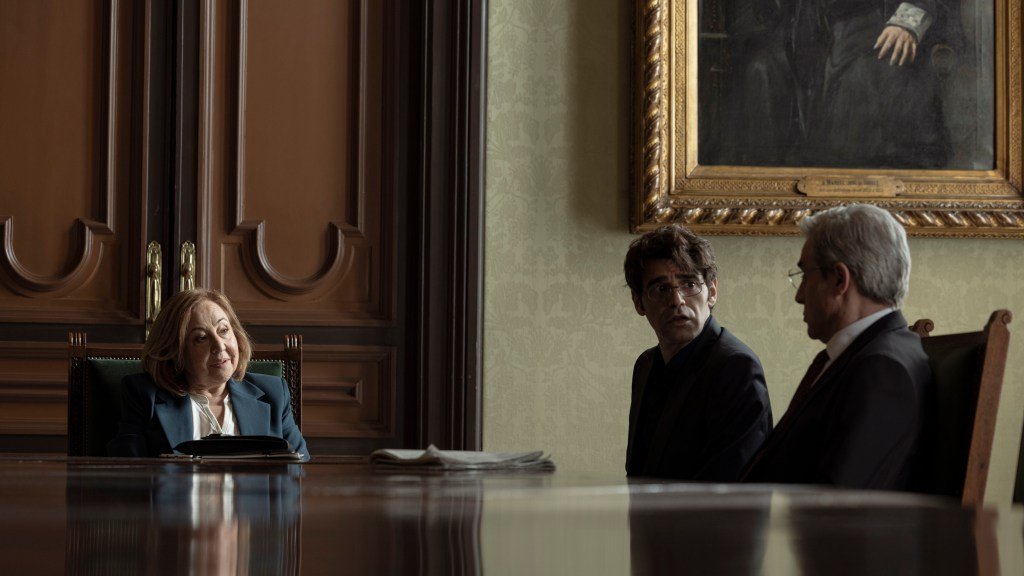
A world premiere, backed by Beta Fiction Spain marking De la Orden’s follow-up to breakout “A House on Fire,” “The Director” is based on David Jiménez’s lid-lifting autobiographical non-fiction book, charting his time trying to lead the digital transformation of newspaper El Mundo, which becomes a record of journalism under pressure from political and economic interests.

‘El Director’
Haigh’s first film since “All of Us Strangers,” “A Long Winter,” set on a farm in the Rockies in the early ’50s, was hailed by Variety as “a sweeping act of cinematic storytelling.”
De la Orden and Haigh are courted directors. One of Seville’s, most exciting facets is its focus on breakout new talent: One whole section at the festival, Rampa, features first and second features from Europe. Debuts also spangle the Seville European Film Festival’s main competition.
Starring “Vikings’” Gustaf Skarsgård, “Adult Supervision,” the first feature of well-known Swedish author and podcast host Alex Schulman, has sold widely by Heretic, including to WBD, Place and Vertigo.
Other new talent highlights Serbian Miroslav Terzić “3 Weeks After,” an unflinching portrayal of brutal high-school bullying, and Abinash Bikram Shah’s thriller “Elephants in the Fog,” set in a Nepalese transgender community which won Cannes Un Certain Regard Jury Prize
Also drawing praise among Golden Giradillo contenders are Eivind Landsvik’s debut “Low Expectations,” a “slow, quiet and life-affirming late coming-of-age tale you don’t want to look away from” driven but its central performance by from Norwegian singer-songwriter-producer Marie Ulven, also known as Girl in Red.
Another Un Certain Regard title, “Words of Love,” the second feature from Rudi Rosenberg, is described by Variety as a a film which captures sensitively captures the chaos and compassion of family.
Underscoring the Range of European Cinema
These new discoveries are joined by the latest films from more established directors such as “Black Money for White Nights,” a probing take on pro-Russia nostalgia from Bulgaria’s Kristina Grozeva and Petar Valchanov, Karlovy Vary Crystal Globe winners with “The Father.”
Also in contention is The Idiot(s), starring Johnny Flynn and Aimee Lou Wood, an “unexpectedly romantic portrait” of Dostoevsky and his wife from Polish duo Małgorzata Szumowska, an EFA and three-time Berlin winner, and well-known cinematographer Michał Englert.
Beyond established auteurs, Seville also programs crossover tiles – think no further than “La Bola Negra,” a star title in a European Film Academy panorama which accompanies the announcement of EFA nominations in Seville. In 2025, Seville program Season 6 of “The Chosen.” It sold out in minutes, Cristóbal recalls. This year, one title turns on Seville soccer club.
“We want to program different films attending the different audiences in Europe. Seville is also the fourth biggest city in Spain, so we ned to expand the scope of the Festival,” says Cristobal.
Andalusia Calls
Seville’s main competition also features another first feature, the buzzy “Taranta,” a doc feature directed by Samuel Nacar and produced by Seville-based Sarao Films. It is set in Lnares, once a boom town until its car factory closed. Now it has one of the highest unemployment rates in Europe. “The principal idea is to ask what it’s like to grow up in a town which you think has no future,” says Nacar. Even when a Chinese company reopens the Linares’ local car plant, the film’s two young Spanish protagonists hesitate between staying or leaving.
An Andalusian Panorama gives some idea of the scale of Andalusia’s output – there are 16 titles – and the quality Andalusian productions ca reach, led by the Womack Studios-produced “Bajañi,” in which Fernando Trueba follows flamenco guitarist Niño Josele as he explores jazz and Brazilian music, playing with is greats, such as Caetano Veloso, Ron Carter and Rubén Blades.
23rd Seville European Film Festival
Main Competition:
“3 Weeks After,” (Miroslav Terzić, Serbia)
“Anguita. El hombre de los tres siglos,” (Hugo Cabezas, griten with Marta Jiménez, José María Martín, Spain)
“Black Money for White Nights,” (Kristina Grozeva, Petar Valchanov, writing with Decho Taralezhkov, Bulgaria-Greece)
“Blaise” (Dimitri Planchon y Jean-Paul Guigue, France)
“Children of the Monkey,” (Tommaso Landucci, co-written with Damiano Femfert, Italy)
“El Director,” (Dani de la Orden, written by Michel Gaztambide, Alejandro Hernández, Spain)
“Elephants in the Fog,” (Abinash Bikram Shah, Nepal-France-Germany-Brazil-Norway)
“Falling House,” (Mohsen Gharaei, written with Amir Mohammad Abdi, Irán)
‘The Idiot(s),” (Małgorzata Szumowska, Michał Englert, written with Kasper Bajon, Poland-Germany)
‘Lemonade’ (Kim Bartley, Ireland)
“Low Expectations,” (Eivind Landsvik, Norway-Denmark)
“Taranta” (Samuel Nacar, from a screenplay by Ana Puentes, Claudia Barthelemy, Spain)
“The Unknown,” (Arthur Harari, penned with Lucas Harari and Vincent Poymiro, France)
“Words of Love,” (Rudi Rosenberg, France)
“You Don’t Belong Here,” (Florin Şerban, Romania)