








The bottleneck in every classroom: Working memory, cognitive load, and the conditions for learning
Throughout my career, I have held various roles (teacher, principal, director of curriculum and instruction, author, speaker, and solutions provider) but I fundamentally see all of them as forms of teaching. The core principle remains unchanged: once a teacher, always a teacher. My actions are consistently guided by one fundamental question: how can we best support students’ learning processes based on cognitive science principles to achieve optimal understanding and retrieval?
That question eventually led me to the science of learning, and specifically to cognitive load theory. It’s a simple idea with enormous implications for how we design classrooms, and I think every educator and every EdTech company that builds classroom products needs to understand it.
The bottleneck we all share
For learning to happen, information has to pass through two memory systems. Long-term memory is where lasting knowledge lives, and it’s effectively unlimited. But nothing reaches it directly; everything has to move first through working memory, the small mental workspace where we actively hold and make sense of new information. That’s the bottleneck every lesson has to move through. Working memory can hold only three to four items at once (Cowan, 2010). If those items make the transfer into long-term memory, they stay with us. That’s how students build durable learning. If they don’t make it all the way through, we forget them.
Everyone deals with this. It’s why we break phone numbers into short chunks instead of holding all ten digits at once: working memory can only juggle a handful of items in any given moment, and chunking is how we work around that limit. Miller’s classic estimate (1956) put the number higher, seven, give or take two, but more controlled research since has revised it down to about four (Cowan, 2010). Either way, the lesson holds: it’s also why we forget someone’s name two minutes after meeting them at a gathering. This isn’t a student limitation or a young-brain limitation. It’s a human-brain limitation.
Two kinds of load — and only one of them helps
Cognitive load theory splits the demand on that bottleneck into two categories (Sweller, 1988; Sweller, van Merriënboer & Paas, 1998). Intrinsic load is the necessary difficulty of the content itself, the load required for students actually to learn the material. Extraneous load is the load imposed by the surroundings: distraction, clutter, anything competing for the same mental space as the learning. Only extraneous load is pure waste. Our brains are built to focus on one important thing at a time, so anything extraneous simply crowds out the material we actually want students to keep.
That distinction reframed how I think about technology in the classroom. My instinct isn’t to keep equipping classrooms with more technology. It’s a better question to ask whether a given tool is reducing cognitive load, removing barriers, and protecting the relationship between the teacher, the student, and the task they’re working on.
Why the explicit, guided approach wins
This is where the research is unambiguous. Novices learn far better with clear, guided, step-by-step teaching than they do being left to discover material on their own, and it comes down to protecting that same narrow channel. Rosenshine’s Principles of Instruction (2012) and Kirschner, Sweller, and Clark’s foundational 2006 paper on minimally guided instruction both point in the same direction: every step protects working memory:
● Small steps that introduce one element at a time
● Modeled examples and discussion before students go it alone
● Guided practice with support before release
● And review spaced out until recall becomes automatic.
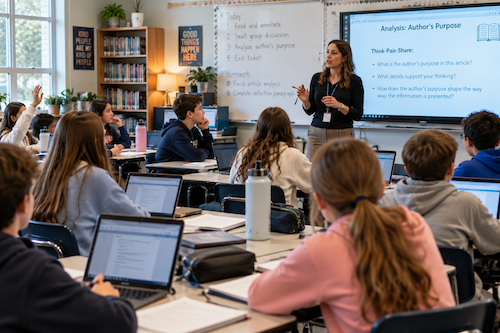
In practice, this means chunking and pacing instruction: seven to eight minutes of instruction, then retrieval, so students can encode what they just heard before you move on. Retrieval isn’t a quick quiz or exit ticket tacked onto the end of a lesson. It’s the mechanism of the learning itself. When you think about the classroom, think about what conditions are most conducive to durable learning — the barriers we can remove, and what the research says deep learning actually requires.
A real classroom example: The acoustic environment
Extraneous load isn’t abstract, and it isn’t rare. Recent classroom measurements found that ambient noise during active instruction averages around 50 decibels, well above the range where researchers consistently see cognitive performance decline (Visentin & Prodi, 2026). I’ve seen this play out in real classrooms over the years. Consider a classroom that doesn’t have equal voice distribution. A student in the further from the teacher doesn’t hear the same lesson as one who happens to be closer to the teacher. Sound diminishes sharply with distance, so that student is already at a disadvantage before a single distraction even hits. Add HVAC noise, hallway sound, and the classroom next door, and the brain now has to reconstruct words it didn’t fully hear.
That reconstruction isn’t free. Recent research on listening effort confirms as much: even after a word is correctly understood, the brain keeps spending working memory tracking down what it thinks was said, because comprehension and reconstruction draw on the same limited resource (Flaherty & Klug, 2026). When noise creates a gap, that reconstruction effort comes straight out of the capacity a student needs for the actual content.
I’ve seen classrooms move from no voice distribution at all to a teacher wearing a microphone paired with classroom audio, so every seat receives that same voice at the same strength, regardless of where a student sits. That’s not a nice-to-have. It’s a direct reduction in extraneous cognitive load, and it benefits every student in the room, not just the ones who already have a formal accommodation in place, with the clearest gains for younger students, whose auditory processing is still maturing, and multilingual learners who are decoding an unfamiliar language on top of new content.
Next steps for the classroom
If you’re an educator or a leader deciding what to invest in next, the question isn’t, “What new tool should we add?” A better question is, “What’s currently competing with learning for a student’s limited working memory, and how do we remove it?”
- Think about the classroom learning conditions and what research says is most conducive for deep learning. What barriers can we remove?
- Audit the environment itself: noise, visual clutter, and redundant text and narration, with the same rigor you’d apply to a lesson plan.
- Explicit, direct instruction is the most well-supported, evidence-based instructional strategy, and that doesn’t mean lecture alone. It includes guided independent practice, worked examples, modeling, and retrieval: all of it requiring direct communication between teacher and student.
- For teachers, chunk instruction for seven to eight minutes. Then practice retrieval, so students can encode. Then provide another seven to eight minutes of instruction. This helps students move information from working memory to long-term memory.
- The pedagogy matters, but so does whether every student can actually hear it. Fixing the environment is not separate from good teaching. It’s what makes good teaching reach every student in the room.