






What Are Your Superstitions? – The New York Times
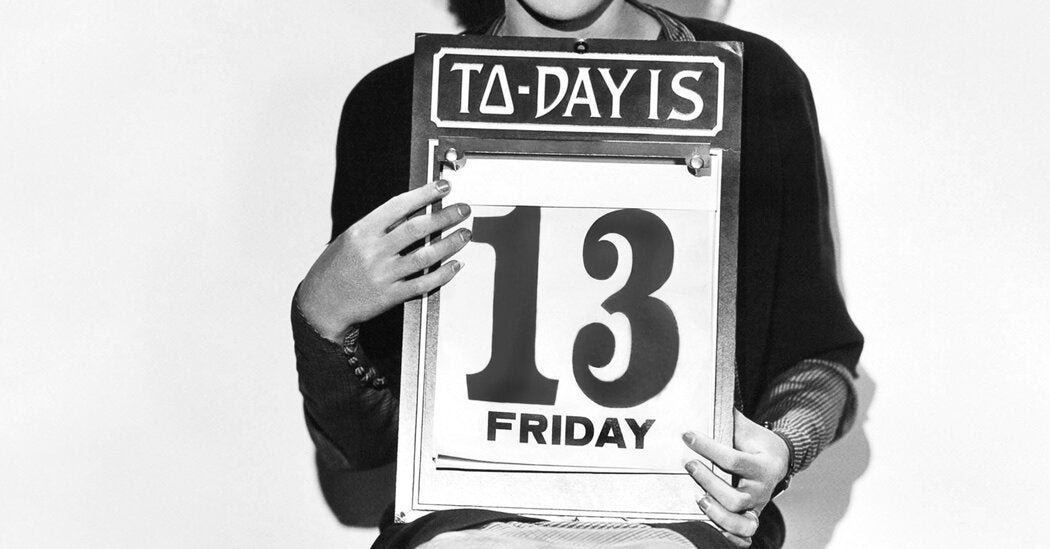
Today is Friday the 13th, a day infamously associated with unlucky things. Not only that, it’s the third, and final, Friday the 13th of 2026. (That’s the most that can occur in a single year, and it won’t happen again until 2037.)
Does Friday the 13th strike you with fear and worry? Or is it just a normal day?
Are there other superstitions, rituals or beliefs that you practice — or avoid — to bring on the good, or ward off the bad in your life?
In “Don’t Be Afraid, but This Is the 3rd (and Last) Friday the 13th of 2026,” Sopan Deb writes about where our fear of Friday the 13th came from:
The origins of the Friday the 13th superstition are murky. It is believed to be a relatively recent Western phenomenon — bad luck is associated with the number 13 in Western culture, while in China, 13 is considered lucky. But that has not stopped people from looking to history or to scripture for clues.
In Christian lore, the apostle Judas, one of 13 people at the Last Supper, is said to have betrayed Jesus Christ on a Friday. Others look to the Knights Templar, the powerful Catholic military-religious order established to protect pilgrims heading to Jerusalem, whose leaders were arrested and tortured on the orders of King Philip IV of France on a Friday the 13th in 1307.
Part of the issue with 13 is that it follows 12 — an easily divisible number long associated with easily digestible things: 12 months in a year, for example, or 12 zodiac signs. Or a dozen doughnuts.
The date has long been a touchstone in American popular culture. “Friday the 13th” became a horror movie staple upon its release in 1980, and was followed by several sequels. But even decades earlier, the negative association with the day was prevalent in early 20th-century cinema, as in the 1916 silent film “Friday the 13th,” which was adapted from a 1907 novel by Thomas William Lawson.
Kendall R. Phillips, a professor in the department of communication and rhetorical studies at Syracuse University, said that early vaudeville sketches like “Superstitious Joe,” from 1913, were full of humorous references to the date. Fixating on Friday the 13th is “really our way of pretending we can control or predict a universe that is uncontrollable and unpredictable,” Dr. Phillips said. “So if you think about it, all the things we think are omens of bad luck — Friday the 13th, walking under a ladder, a black cat crossing your path — all those just become ways for us to try to make sense of the reality that is — stuff just happens.”
Students, read the entire article and then tell us:
-
What does Friday the 13th mean to you? Are there things that you avoid or do to ward off bad luck on a day like today? Or do you live your life normally?
-
Are you superstitious in general? Why or why not? What situations or events, if any, are most likely to bring out your superstitious side?
-
Tell us about a superstition of yours that isn’t rooted in science or fact, but that you feel the need to adhere to nonetheless. For example, do you have a good-luck charm that you wear or carry with you? A routine that you always perform before playing a big game or going onstage? A family folk tale whose inferences you make sure to follow? How did this habit start, and why do you stick with it?
-
Dr. Phillips said in the article that fixating on superstitions like Friday the 13th is “really our way of pretending we can control or predict a universe that is uncontrollable and unpredictable.” What do you think about that? Why do you think people might participate in rituals or beliefs that don’t necessarily make sense?
Student Opinion, produced by The Learning Network, invites teenagers to add their voices to the conversation around New York Times articles. Find a teaching guide here.
Students 13 and older in the United States and Britain, and 16 and older elsewhere, are invited to comment. All comments are moderated by the Learning Network staff, but please keep in mind that once your comment is accepted, it will be made public and may appear in print.