








Why one-off AI training will not prepare teachers
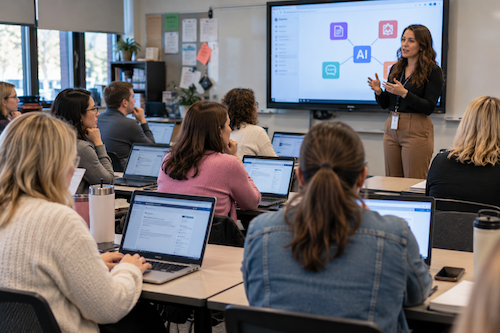
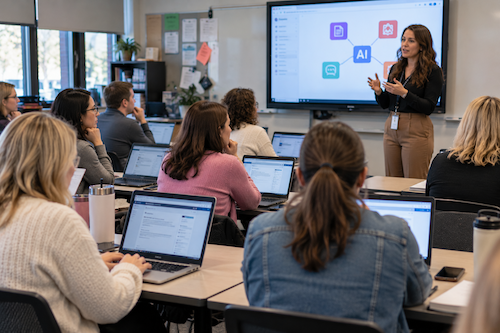
Across K–12 education, districts are moving quickly to help teachers understand artificial intelligence. They are offering workshops, creating guidance, identifying approved tools and developing resources to support responsible use.
We see real value in that work. Teachers need clear guidance on privacy, accessibility, academic integrity and the appropriate use of AI with students. They also need opportunities to understand what these tools can do before deciding where they belong in their teaching.
Yet a teacher can leave an AI workshop with a good understanding of a tool and still sit down to plan tomorrow’s lesson unsure of what to do with it. So many of the decisions teachers make about AI depend on context. Will using it here strengthen what students are learning? Can I trust what it produced? Will all of my students have meaningful access to it? What should students work through themselves? Where does my own judgment matter most?
Teachers encounter these decisions while designing lessons, revising assessments, responding to students and solving the everyday instructional problems that rarely fit neatly into a professional development session. Helping teachers navigate those moments requires sustained opportunities to learn, experiment and talk through what they are seeing in their classrooms.
What We Heard From Educators
Our thinking here draws in part from research in higher education, so we want to be careful about what we take from it. In a research-practice partnership conducted by Digital Promise with support from D2L, faculty, staff and instructional leaders explored how educators used instructor-facing AI across several higher education settings.
We did not conduct the study to tell K–12 districts how to approach AI. Schools and colleges operate differently, and teachers face their own set of responsibilities, constraints and relationships with learners. Still, one finding has stayed with us. Educators often found AI support most useful when someone connected it to a problem they were already trying to solve.
One participant knew professional development opportunities were available but had put them off because they did not feel immediately relevant. Then the educator ran into a problem creating weekly course overviews, and an instructional designer demonstrated how an AI capability could support that specific task. The participant described it as an “I-need-it” moment.
In K–12 classrooms, teachers often make these instructional design decisions themselves. That makes access to a trusted colleague especially valuable when they want to think through where AI might fit into a lesson, assessment or other learning experience.
The participant’s phrase captures something important about how educators learn. Relevance grows when a new capability meets a real need. In this case, the educator had a task to complete, a trusted colleague who understood the instructional context and an opportunity to explore whether AI could actually help.
For district leaders, the experience offers something worth considering as they design professional learning for teachers. Giving educators access to AI tools and explaining how those tools work gives them a starting point. Teachers also need people they trust who can help them work through decisions as those decisions arise in practice.
Teachers Need Time to Develop Judgment
A workshop can introduce common language, district expectations and important considerations around privacy, ethics, accessibility and academic integrity. Those are valuable outcomes, but developing good instructional judgment around AI takes continued practice.
Teachers need opportunities to try what they have learned, inspect the results and reconsider their choices as both the technology and their understanding develop. A strategy that makes sense for a ninth-grade history assignment may make little sense in a third-grade classroom. An appropriate use of AI during lesson planning may raise very different considerations when students use the same capability themselves.
Teachers need space to work through those distinctions with people who understand their work. Many districts already have instructional coaches, curriculum specialists, technology integrationists, library media specialists, special education and accessibility leaders, principals and teacher leaders who spend their days helping educators connect new ideas to classroom practice.
Smaller and rural districts may rely on regional service agencies or a small group of educators who work across several schools. Every district will organize this support differently, and the particular job title matters far less than giving teachers access to people who understand instruction, know the local context and have enough experience with AI to help colleagues think through its use.
Bring AI Learning Closer to the Work
Districts do not need to discard workshops or turn every instructional coach into an AI expert. They do need an AI strategy that can evolve as the technology, district policies and educators’ needs change. Professional learning should support that strategy by helping teachers put it into practice, test what works in their classrooms and bring what they learn back into the district’s approach.
Offering professional learning, on its own, does not amount to an AI strategy. District leaders still need to make decisions about instructional goals, governance, tool evaluation, student use and the role educators should play in shaping how AI enters teaching and learning. Professional learning gives teachers and the people who support them a way to connect those decisions to the work happening in classrooms every day.
That could mean involving instructional coaches and teacher leaders in AI governance and tool evaluation so they understand the reasoning behind district decisions. Districts could give them protected time to experiment before asking them to support colleagues and make help available when teachers plan curriculum, design assessments or examine student work.
Districts can also create space for educators to talk openly about uses of AI that did not work. Teachers learn a great deal from seeing where a tool produced an unreliable answer, created more work, reduced the intellectual demand of an assignment or simply failed to help. Sharing those experiences can give educators a richer understanding of when AI belongs in their practice and when another approach makes more sense.
We would also encourage district leaders to think carefully about what they measure. More AI use does not necessarily tell us that teachers feel better prepared to make decisions about it. Measures of professional learning should help districts understand whether educators can evaluate AI critically, make choices that support learning and explain the reasoning behind those choices.
Give the People Supporting Teachers Support Too
As districts build their AI plans, they also need to consider the people they expect to support teachers. Instructional coaches and teacher leaders can easily inherit a new responsibility without gaining the time or preparation to carry it well. Calling someone an “AI champion” does little if that person already has a full workload and has received little opportunity to develop their own knowledge.
The educators supporting their colleagues need time to experiment, opportunities to work with peers and access to district leaders who can answer questions about policy, curriculum, technology and student needs. Districts should also give them enough authority to raise concerns when a tool does not serve an instructional purpose.
Their role should never require them to promote AI simply because the district approved a particular tool. Their value comes from helping teachers examine instructional fit, identify risks, protect student learning and decide whether AI contributes something useful to the work in front of them.
Build Capacity Around the Decisions Teachers Actually Make
AI will keep changing, and educators will keep encountering situations that no workshop could have anticipated in advance. Professional learning needs enough flexibility for teachers to bring those situations back to colleagues, learn from what happened and apply that experience the next time they face a similar decision.
The higher education research gives us an early signal worth exploring. Educators may find AI learning more meaningful when they can connect it to an immediate instructional need and work through that need with someone who understands their practice. K–12 districts now have an opportunity to learn what that looks like in their own schools by listening to teachers, studying how educators make decisions about AI and giving the people supporting them enough time to learn alongside them.
When we think about preparing teachers for AI, we keep coming back to the judgment educators exercise every day. Teachers need to feel confident deciding when AI can support learning, when another approach would serve students better and what their students need from them in that moment.
That judgment develops over time through practice, conversation and reflection with people educators trust. Giving teachers the time and support to develop it can help them connect new capabilities to the students in front of them and to the purposes that brought them to education in the first place.


