







‘Wildwood,’ ‘Forgotten Island’ Filmmakers at ‘Pixels & Pencils’ Panel
As artificial intelligence continues to advance, animators are increasingly facing questions about the future of their craft and the role of human creativity in filmmaking. But the majority are not interested in letting AI into their art of storytelling.
At Variety‘s “Pixels and Pencils” panel in Savannah, Georgia on Monday, leading filmmakers discussed the process of bringing animated stories to life and why technology can’t replace the work behind them. Six panelists joined Variety‘s Clayton Davis for the discussion, which was moderated in partnership with SCAD Savannah Film Festival. They included Brad Bird for Netflix’s “Ray Gunn”; Daniel Chong for Pixar’s “Hoppers”; Joel Crawford and Januel Mercado for DreamWorks Animation’s “Forgotten Island”; Travis Knight for Laika’s “Wildwood”; and Leah Nelson for Independent Film Company’s “Tangles.”
Meg Weichman, the artistic manager of SCAD’s Theatres and Festivals, introduced this year’s panel, which she described as a celebration of the “imagination, artistry and collaboration that brings extraordinary animated stories to life.”
But to make something “extraordinary” requires significant effort, which is part of what makes the process “magical,” Chong said.
“Every set, every character, every piece of cloth, every piece of hair, every moment of atmosphere, all of that is created and made from ground zero. There’s no camera you can point at,” Chong told the audience. “It’s just completely fabricated and made and created, and that’s a pretty amazing thing, because that’s one of the reasons why I think these movies take so long, is because they have to create their own world.”
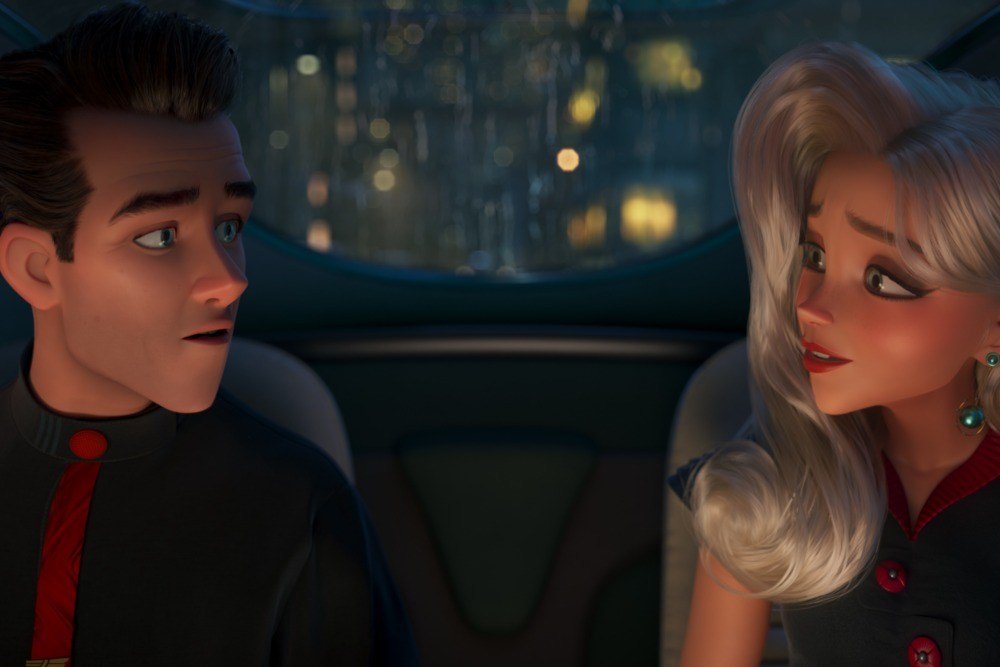
Creating an animated film typically takes well over a year — and sometimes much, more more. From the first idea to its big-screen release, Bird’s “Ray Gunn” took roughly 30 years to finalize, though he wasn’t consistently working on the film throughout that period.

“Ray Gunn” is voiced by Sam Rockwell and Scarlett Johansson.
‘Ray Gunn’ ©2026 Skydance Animation
But Bird was willing to put in the work, saying that a good story “has to come from life. You can’t create the illusion of life without having one, and that’s what we are in charge of — making the illusion of life and bringing people to something new.”
“Wildwood” also required an extensive production process, especially considering it used stop-motion animation. The film used 2,800 shots, a process Knight described as a “pain.”
“Stop motion is progressive. You start on frame one and you work your way all the way through in slow motion until you have a performance,” he said. “There is something extraordinarily magical about being a part of that.”
Despite the time and effort needed, the filmmakers said the process is what makes work meaningful. Chong added, “When you see people taunting that, ‘Oh, I can make this with the click of a button,’ or, ‘I can do this with these shortcuts,’ I think we just have to have faith that these processes are the way they are, and they’re as hard as they are to make for a reason, because that’s what makes these movies great and that’s what makes them resonate with humans.”
The panelists agreed that the humanity behind these films allows stories to resonate with audiences — something AI can’t replicate. But the industry’s future remains uncertain as technology advances and animators continue to adapt. Bird advised artists in the audience to keep learning the ins and outs of animation as the field evolves .
The filmmakers also discussed how different animation styles can shape of story. Deciding whether to use 2D animation, 3D animation, stop motion or even Claymation depends on the film’s narrative, Mercado said.
“It really is the story that dictates the visual storytelling and drive of the characters,” he shared. “That’s how we were able to play with various styles of anime and manga that followed the character point of view in these sections of [‘Forgotten Island’].”
“Forgotten Island”
DreamWorks Animation
Crawford added, “For ‘Forgotten Island,’ we’re like, ‘This is an exploration of memories and how we experience them’ and thinking we all reflect memories in different ways. To have the animation style switch up depending on who the teller of the memory is was just a really exciting opportunity.”
The panelists also challenged the common misconceptions of working as an animator, which for “Tangles” director Nelson, included actually needing to be an animator.
“What I had to do, because I’m not an animator, was do everything else to communicate the vision — anything I could think of to communicate to my team what I hoped for and what I wanted to fight for,” she said. “I used all the other tools I could think of. I did a lot of acting references. I filmed myself doing the actions if I couldn’t draw it.”